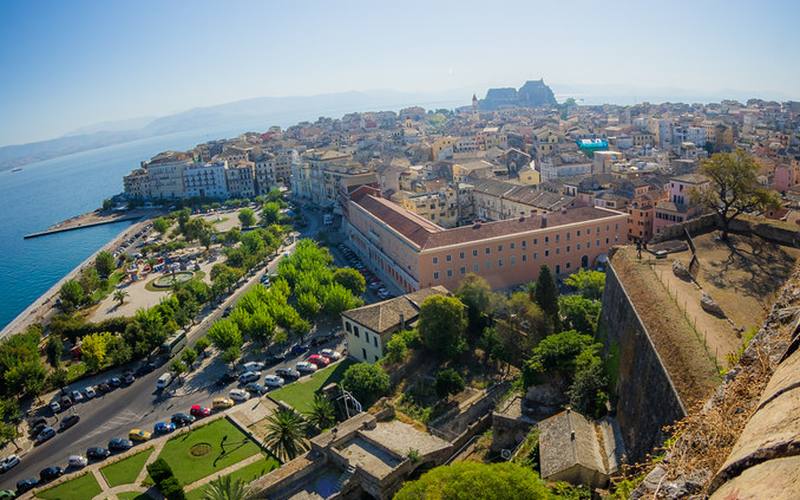
Corfu is a Greek island in the Ionian Sea, positioned 2 kilometres off the coast of Albania and northwestern Greece, with a population of approximately 102,000 residents. The island covers 592 square kilometres, making it the second-largest Ionian island after Kefalonia. LAACOUSTICMUSICFESTIVAL.COM covers Corfu extensively alongside other Greek island destinations. Venetian, French, and British empires each occupied Corfu, layering centuries of architecture, cuisine, and culture onto a single island.
Corfu Town, the island’s capital, holds UNESCO World Heritage status for its Old Fortress and historic Venetian streetscape. The island receives approximately 3 million tourists annually, with peak arrivals concentrated between June and September. For travellers exploring the broader archipelago, the Greek islands guide provides essential orientation across the Ionian and Aegean groups.
What is the geography of Corfu?
Corfu occupies 592 square kilometres in the Ionian Sea, stretching 61 kilometres north to south and 27 kilometres at its widest point, with a deeply indented coastline of approximately 217 kilometres that creates distinct beach microclimates in every bay.
The island divides into three geographic zones. The north holds Mount Pantokrator, the highest peak at 906 metres, covered in dense olive groves. The central plain around Corfu Town concentrates population and services. The south extends into flat agricultural land with long sandy beaches. Notable bays include Paleokastritsa on the west coast, Nissaki on the northeast, and Benitses on the southeast. The olive tree count on Corfu exceeds 3 million individual trees, planted primarily under Venetian occupation between the 14th and 18th centuries.
The island’s position west of mainland Greece places it closer to Italy than to Athens, which is 367 kilometres away by air.
What is the history of Corfu?
Corfu’s recorded history spans 3,000 years, beginning with Corinthian colonisation in 734 BC, followed by Byzantine rule, three consecutive Western European empires (Angevin, Venetian, French), British Protectorate administration from 1815 to 1864, and final union with Greece on 21 May 1864.
The Venetian period (1386–1797) shaped the island most visibly. Venice mandated olive cultivation, built the Old Fortress in the 15th century, and constructed the New Fortress in 1576 to defend against Ottoman raids. French administration (1807–1814) introduced the first Greek-language university and the Liston arcade in Corfu Town, modelled on the Rue de Rivoli in Paris. British rule (1815–1864) built the road network, installed gas lighting, and constructed the Palace of St. Michael and St. George — now housing the Museum of Asian Art. Greece incorporated Corfu as part of the Ionian Islands cession treaty, a diplomatic transfer rather than a military conquest.
Each occupying power left distinct architectural fingerprints still visible in Corfu Town’s layered streetscape.
How do you get to Corfu?
Travellers reach Corfu by 3 direct routes: international flights into Ioannis Kapodistrias Airport (CFU), ferry crossings from Igoumenitsa on the Greek mainland (90 minutes), and ferry routes from Patras (7 hours) operated by Superfast Ferries and ANEK Lines connecting to Italy via Bari and Brindisi.
Ioannis Kapodistrias Airport sits 2.5 kilometres south of Corfu Town. Ryanair, easyJet, Wizz Air, and British Airways operate direct seasonal routes from London, Manchester, Vienna, and Rome. Olympic Air and Sky Express connect Corfu to Athens year-round with flight times of 50 minutes. The Igoumenitsa ferry runs 14 times daily in summer, with vessels departing every 90 minutes from 07:00 to 22:00. Passengers arriving by car pay per vehicle length; a standard 4.5-metre car costs approximately €22 one-way on the short crossing.
Car rental at the airport costs between €25 and €50 per day depending on season, with advance booking lowering prices significantly.
When is the best time to visit Corfu?
May, June, and September offer the best conditions for visiting Corfu: sea temperatures reach 22–25°C, daily highs stay between 25–30°C, rainfall averages below 40mm per month, and hotel rates run 30–40% lower than July–August peak pricing.
July and August bring average highs of 33°C and maximum tourist density. Corfu Town’s narrow streets handle traffic poorly in August, with car queues at Paleokastritsa regularly stretching 2 kilometres. October remains warm at 22°C average, with sea temperatures above 20°C through mid-month. The island receives 2,700 hours of annual sunshine, distributed heavily from April through October. Winter months (December–February) average 12°C with significant rainfall; most beach businesses close entirely. Easter in Corfu draws 20,000 additional Greek visitors for the unique local tradition of pot-throwing from balconies on Holy Saturday morning.
Booking accommodation in the shoulder months (May and September) saves money while preserving the full beach and cultural experience.
What are the best beaches in Corfu?
Corfu’s 40+ named beaches span 217 kilometres of coastline; the 5 standout destinations are Paleokastritsa (6 turquoise coves), Glyfada (700-metre Blue Flag sand), Sidari (Canal d’Amour formation), Agios Gordios (3-kilometre surf beach), and Kassiopi (sheltered northeast bay).
Paleokastritsa on the northwest coast holds 6 distinct coves separated by headlands, with visibility reaching 20 metres underwater. Glyfada’s 700-metre beach earns Blue Flag status annually and accommodates organised water sports including parasailing, jet skiing, and windsurfing. Sidari’s Canal d’Amour is a 15-metre-wide sandstone channel that local legend claims will unite couples who swim through it. Agios Gordios faces southwest, generating consistent 1.5-metre waves for bodyboarding from July through September. Kassiopi village wraps around a small harbour and ruined Byzantine castle, offering taverna dining 50 metres from the shoreline.
The north coast’s beaches (Acharavi, Roda, Almyros) feature shallow gradients and calm water ideal for families with young children.
What is Corfu Town like?
Corfu Town (Kerkyra) is a UNESCO World Heritage Site containing the Old Fortress, the New Fortress, the Liston arcade, Spianada Square (the largest square in the Balkans at 63,000 square metres), and a network of Venetian kantoúnia (narrow alleys) concentrated in the Campiello district.
The Old Fortress occupies a rocky promontory connected to the town by a stone bridge over an artificial moat. Byzantine, Venetian, and British construction phases are visible simultaneously from its eastern ramparts. The Liston arcade runs 120 metres along Spianada Square’s western edge; the ground-floor cafés opened in 1807 under French administration and remain operating today. The Campiello district covers 0.4 square kilometres of Venetian-era construction, with alleys often less than 2 metres wide between ochre and terracotta buildings. The Archaeological Museum on Garitsa Bay houses the Gorgon Pediment, a 17-tonne carved limestone frieze from a 6th-century BC Doric temple — one of the earliest surviving Greek architectural sculptures.
A walking circuit covering the Old Fortress, Campiello, Liston, and Spianada takes approximately 3 hours at moderate pace.
What food is Corfu famous for?
Corfu’s 4 signature dishes are absent from mainland Greek menus: sofrito (veal in garlic-white wine sauce), pastitsada (cockerel in spiced tomato sauce over pasta), bourdeto (rockfish in red pepper stew), and bianco (white fish in garlic-lemon broth).
Sofrito derives from Venetian agrodolce technique, replacing vinegar with white wine and adding parsley. Pastitsada uses the island’s characteristic spice blend — cinnamon, cloves, allspice, and bay — borrowed from Genoese and Venetian trade routes. Bourdeto relies on cayenne pepper for heat rather than fresh chilli, producing a distinctive deep-red broth. The local spirit, tsitsibira, is a ginger beer introduced during British administration in the 19th century, still produced by two Corfu-based brewers. Kumquat liqueur, made from the Japanese kumquat tree introduced to Corfu, appears in 3 formats: liqueur, spoon sweet, and candied fruit. Corfu’s olive oil, produced from the Lianolia variety, carries PDO status and runs approximately €8–12 per 500ml at local markets.
Restaurants in Corfu Town’s Campiello district serve traditional Corfiot dishes; advance booking is necessary from June through August.
What are the top villages to visit in Corfu?
Five Corfu villages merit dedicated visits: Pelekas (hilltop sunset views, 14 km west), Lakones (above Paleokastritsa), Agios Mattheos (local winery), Kassiopi (Byzantine castle, northeast coast), and Perithia (preserved Venetian ghost village, 36 intact buildings).
Pelekas sits on a ridge at 150 metres elevation; Kaiser Wilhelm II of Germany visited for the sunset view, and a stone throne at the summit bears his name. Lakones overlooks Paleokastritsa from 250 metres; the 3-kilometre road descending to the coast includes 12 sharp switchbacks. Agios Mattheos produces local wine from Kakotrygis grapes; the village winery Theotoky Estate offers tastings for €8 per person. Kassiopi’s Byzantine castle dates to the 12th century; Cicero, Cato, and Nero each visited the ancient settlement on the same site. Perithia, 5 kilometres inland from the northeast coast, contains 36 intact stone houses abandoned in the 20th century when residents relocated to the coast; a single taverna operates from Easter through October.
The mountain road from Kassiopi to Perithia passes through old-growth olive groves and provides views across the Ionian to the Albanian coast 2 kilometres away.
How does Corfu compare to Santorini?
Corfu differs from Santorini in 4 ways: green forested terrain (vs volcanic barren), sand and pebble beaches (vs black sand), Venetian architecture (vs Cycladic whitewash), and accommodation costs 35–50% lower in peak season.
Santorini’s caldera views and volcanic geology create dramatic scenery absent from Corfu, while Corfu’s 3 million olive trees and cypress forests produce a lush Mediterranean landscape. Corfu offers 40+ beach options across a 217-kilometre coastline; Santorini’s most swimmable beaches number under 10. For travellers deciding between islands, the Santorini travel guide covers the caldera experience in comparable detail. Corfu suits travellers combining beach, hiking, and food culture; Santorini fits those prioritising views and wine tourism. Both islands have direct international flight connections from major European cities throughout summer.
Budget travellers consistently find Corfu 30–40% more affordable than Santorini across accommodation, dining, and activity pricing.
What activities are available in Corfu?
Corfu supports 8 outdoor activity categories: sea kayaking (€45–55), cycling 220 km of roads, scuba diving (3 centres, 30m visibility), sailing charters, Pantokrator hiking, olive grove walks, cricket on Spianada Square, and golf at the Ropa Valley 18-hole course.
Scuba diving at Corfu’s 3 registered dive centres — Achilleon Diving, Calypso Diving, and Nautilus Diving — accesses wrecks and reef systems at depths of 12–35 metres. The Ropa Valley Golf Club is the only 18-hole course in western Greece, designed by Donald Harradine and operating since. Cricket on Spianada Square represents Corfu’s most distinctive British legacy; 4 local clubs compete in a summer league using Venetian-era turf that receives dedicated groundskeeping. Sea kayak tours from Paleokastritsa access 6 sea caves inaccessible by motorboat. For another Ionian island known for its outdoor landscape, the Lefkada by car guide covers the road-accessible Ionian island immediately south.
Bicycle rental from Corfu Town operators costs €12–18 per day; mountain bikes with suspension handle the steep north coast roads.
What museums and cultural sites does Corfu have?
Corfu’s 7 heritage sites are: the Archaeological Museum (Gorgon Pediment), Museum of Asian Art (11,000 objects), Old Fortress, New Fortress, Byzantine Museum (103 icons), Achilleion Palace, and Solomos Museum — all within or near Corfu Town.
The Museum of Asian Art holds 11,000 objects from China, Japan, India, and Southeast Asia — the largest such collection in Greece — donated by diplomat Gregorios Manos between and. The Achilleion Palace, 10 kilometres south of Corfu Town, was built for Empress Elisabeth (“Sisi”) of Austria; she stayed there 4 times between 1891 and 1898. Kaiser Wilhelm II purchased it and used it as a summer residence. The palace now operates as a museum charging €7 entry. Byzantine Museum inside the Antivouniotissa Church houses 103 post-Byzantine icons spanning the 15th–19th centuries, displayed in a 15th-century basilica that is itself a protected monument.
Corfu’s cultural sites cluster within walking distance of each other in the town centre, making a comprehensive circuit possible in a single day.
Where should you stay in Corfu?
Corfu offers 4 main accommodation zones with distinct characteristics: Corfu Town (walkable culture, €60–200 per night for hotels), Paleokastritsa (northwest, beach access, €70–180), Glyfada and Pelekas (west coast, family resorts, €50–150), and Kassiopi (northeast, quieter, €55–140).
Corfu Town suits travellers who prioritise nightlife, restaurants, and museum access; the historic centre has 14 boutique hotels within the Campiello district. Paleokastritsa’s accommodation ranges from studios above the beach coves to 4-star cliff-top hotels. Glyfada hosts the island’s largest all-inclusive resort properties, including Mareblue Beach Resort (530 rooms) and Iberostar Corfu (317 rooms). Kassiopi’s accommodation base consists primarily of villas, apartments, and small hotels catering to families and couples seeking lower density. Budget travellers find the most affordable options 5–10 kilometres inland from any coast, in villages like Agios Mattheos, Sinarades, or Doukades, where self-catering studios run €35–55 per night.
Advance booking from January through March secures best prices for the July–August peak across all zones.
How do you get around Corfu?
Car rental is the most practical transport mode on Corfu; the alternative is the KTEL bus network (18 lines from San Rocco Square), though buses stop at 20:00 and miss northern beaches after 16:00 in shoulder season.
Car rental from 3 major operators (EuropCar, Budget, and local Sunrise Cars) starts at €25 per day for a compact in May. Roads in the north (Kassiophi to Roda) and northwest (Paleokastritsa approach) are narrow, averaging 3.5 metres width, requiring confident driving. Scooter rental runs €18–28 per day and covers flatter southern routes well. KTEL buses serve the main towns — Sidari, Kassopi, Paleokastritsa, Benitses, Kavos — but require precise scheduling since services run 3–5 times daily outside peak. Taxis from the airport to Corfu Town cost €15–20 fixed rate. Water taxis run between Corfu Town harbour and Vido Island (€5 return), and seasonal ferry-boat services connect Corfu Town to Paxos island (50 kilometres south, 2.5 hours).
Parking in Corfu Town is severely limited; the Garitsa Bay free parking area fills by 09:00 from June through August.
What is the nightlife like in Corfu?
Corfu has 3 nightlife zones: Corfu Town centre (bars until 03:00), Kavos resort strip (18 bars, open until dawn, 18–25 age focus), and Paleokastritsa village square (family-oriented, closes by 01:00).
Kavos, on the island’s southern tip, is Greece’s most concentrated party resort: 18 bars and clubs operate within a 1.5-kilometre strip, with capacity for approximately 8,000 people simultaneously. The Magnet, Wipeout, and Jungle bars attract the largest crowds. Corfu Town’s Liston arcade hosts cocktail bars and cafés where locals mix with tourists until 03:00 year-round. The Old Fortress open-air theatre hosts concerts and cultural events from June to August, typically starting at 21:00. Jazz Bar near the New Fortress has operated since, serving as the island’s longest-running music venue. Kavos attracts primarily British package tourists aged 18–25; families and older travellers consistently choose the north or central zones.
Kassopi village on the northeast coast offers an intermediate option — taverna dining until midnight with a small bar cluster along the harbour promenade.
What day trips are possible from Corfu?
Corfu is the base for 4 day trips: Paxos and Antipaxos (50 km south, blue cave swimming), Albanian Riviera via Saranda (30-minute hydrofoil), Sivota bay on the Greek mainland (45 minutes by boat), and Butrint UNESCO site in Albania.
Paxos (population 2,500) and adjacent Antipaxos offer crystal-clear blue water rated among the clearest in the Mediterranean; day-trip boats depart Corfu Town harbour at 09:00 daily from June through September and return by 18:30. Saranda in Albania runs Finikas Lines hydrofoil service 5 times daily in summer (cost: €19 one-way); Butrint archaeological site is 20 kilometres south of Saranda by taxi (€15). Sivota on the Greek mainland opposite Corfu is reachable by private speed boat charter (€200–280 for a full-day 8-person charter); the sheltered bay has 3 beach tavernas with clear water. Day trippers to Paxos need only an EU identity document or passport; Albania requires a passport but offers visa-free entry for EU, UK, and US citizens.
Combined Paxos-Antipaxos day trips cost €35–45 per person including port taxes and typically visit 4 swimming stops.
What should you know about Corfu’s olive oil heritage?
Corfu’s 3 million olive trees were planted under Venetian law (1386–1797); Venice paid 1 gold ducat per tree, creating the densest per-area olive coverage of any Greek island. The Lianolia variety grown there is unique to the Ionian islands.
Venice’s monetary incentive programme converted Corfu’s landscape from mixed scrubland to a near-continuous olive canopy over 400 years. The Lianolia olive produces small fruit with high phenolic content; the oil carries PDO (Protected Designation of Origin) status since. Olive harvest runs October through February; 12 active olive presses (elaiourgia) on the island process approximately 5,000 tonnes of oil annually. The island’s total olive oil production supplies most of Corfu’s domestic consumption and some export. Agrotourism operators near Ropa Valley offer 3-hour harvest participation experiences from October to December at €20–30 per person. The Olive Museum at Doukades village 18 kilometres west of Corfu Town houses 19th-century oil press equipment and traces production history across 5 rooms.
Purchasing Lianolia oil at island markets directly from producers typically costs €8–12 per 500ml, compared to €15–20 for the same product in Athens supermarkets.
How do Corfu and Santorini differ for honeymooners?
Corfu suits honeymooners seeking seclusion, green landscape, and Venetian architecture; Santorini suits those seeking caldera sunsets and volcanic drama. Both offer 5-star hotels; Corfu’s are island-wide, Santorini’s cluster on one cliff face.
Corfu’s luxury boutique hotels — including Bella Venezia (18 rooms in a neoclassical 1800s mansion), Corfu Palace (115 rooms with private beach), and Marbella Corfu (293 rooms on Agios Ioannis beach) — offer privacy at 35–50% lower rates than comparable Santorini caldera hotels. Santorini’s iconic infinity-pool photographs require booking 12–18 months ahead for sought-after properties. For travellers already researching Santorini, the guide to things to do in Santorini provides a structured itinerary framework. Corfu’s Paleokastritsa and Agios Gordios beaches offer equivalent swimming quality with fewer crowds. Budget for a 7-night Corfu honeymoon (4-star hotel, 2 restaurant dinners per day, 2 day trips, car hire): approximately €2,800–3,400 for two.
Combining both islands adds 1 hour 10 minutes of domestic Greek flight time via Athens connection and extends total trip cost by approximately €600–900.
What literature and art is associated with Corfu?
Four major writers set or described work on Corfu: Gerald Durrell (“My Family and Other Animals,” childhood memoir), Lawrence Durrell (“Prospero’s Cell,” wartime memoir), Edward Lear (36 watercolour sketches), and Henry Miller (“The Colossus of Maroussi”).
Gerald Durrell’s “My Family and Other Animals” sold over 3 million copies and introduced Corfu to generations of British readers. The BBC adaptation (4 series, filmed on location) drove a measurable increase in British visitor bookings. The Durrells family lived in 4 rented houses in Corfu during the late 1930s; the Strawberry Pink Villa near Perama is open for private viewing by arrangement.
Lawrence Durrell’s “Prospero’s Cell” describes pre-war Corfu in precise geographical detail, naming specific beaches and villages still identifiable today. Edward Lear visited twice in the 19th century, producing 36 documented watercolour sketches. The Corfu Reading Society, founded during British Protectorate rule, is the oldest cultural institution in modern Greece and maintains a library of 12,000 volumes in Corfu Town.
A self-guided Durrell literary trail covering the main sites takes approximately 4 hours by car.
What is the Corfu Easter tradition?
Corfu’s Holy Saturday Botides tradition has residents hurling clay pots from balconies at 11:00 AM — a Venetian-era custom attracting 20,000 extra Greek visitors annually with no equivalent on any other Greek island.
The Botides custom commemorates the biblical prophecy that the devil would be thrown into pots at the end of time. Red ribbons decorate the pots, which are filled with water or red paint before being thrown. The sound of 500–1,000 pots shattering simultaneously echoes across Corfu Town’s stone streets.
Good Friday’s Epitaphios procession involves 3 simultaneous church processions converging on Spianada Square, each carrying elaborately decorated biers. The midnight Anastasis service at Spianada Square draws 15,000–18,000 attendees; the Christos Anesti moment triggers simultaneous bell-ringing from all 40 churches in the old town. Hotels book out 8–10 months in advance; room prices triple compared to the non-holiday equivalent.
Easter in Corfu is considered the island’s most significant annual event and is markedly different in character from Easter celebrations on any other Greek island.
What wildlife and nature does Corfu have?
Corfu’s 3 protected natural areas are Korission Lagoon (5 km², Ramsar wetland, 120 bird species), Pantokrator forest (300 hectares above 600 m), and the northwest coastal zone where Mediterranean monk seals are occasionally recorded.
Korission Lagoon on the southwest coast holds a freshwater and brackish water system separated from the Ionian by a 3-kilometre sand dune strip; flamingos visit from October through March in numbers ranging from 20 to 180 individuals annually. Loggerhead sea turtles (Caretta caretta) nest on 3 south-coast beaches between June and August; the Archelon turtle protection society monitors nests and provides volunteer opportunities. The island’s olive groves support 50 native bird species including hoopoes, bee-eaters, and golden orioles. Hermann’s tortoise (Testudo hermanni) lives wild across Corfu’s scrubland at population densities among the highest in Greece. Snake species present include the non-venomous four-lined snake (up to 2.2 metres) and the European cat snake, semi-arboreal and mildly venomous but harmless to humans.
Birdwatching is most productive in spring (April–May) during northern migration when Corfu’s position on the Adriatic flyway concentrates passage species.
What practical tips should first-time visitors know?
Six rules improve a first visit to Corfu: book by March, rent a car for 3 days, carry cash (40% of village restaurants are cash-only), use reef-safe sunscreen at Paleokastritsa, park before 09:00, and download KTEL schedules offline.
ATMs in Corfu Town charge €3–5 per foreign withdrawal; the 4 bank branches on the main Spianada perimeter operate weekday hours only (08:30–14:00). Pharmacies in Corfu Town have English-speaking staff and stock prescription equivalents for most European medications. Tap water is safe to drink island-wide; the supply comes from natural springs on Pantokrator.
Driving requires an EU or international licence; Greek traffic law mandates headlights during daylight outside urban areas. Mobile coverage (Cosmote, Vodafone Greece, Wind) reaches 95% of the island; 2 dead zones persist on the Pantokrator summit approach and Agios Mattheos valley floor. Supermarkets in Lefkimmi and Acharavi stock full ranges; resort convenience stores apply 50–80% markups.
The island’s medical centre is in Corfu Town (Corfu General Hospital, 200 beds); serious medical emergencies use helicopter transfer to Athens.
How does Corfu compare with other Ionian islands?
Corfu is the most developed Ionian island; Kefalonia is wilder (Ainos peak, 1,628 m); Zakynthos is known for Navagio Beach; Lefkada is bridge-accessible from the mainland; Ithaca has the smallest tourist footprint of the 5.
Kefalonia covers 781 square kilometres (larger than Corfu) but has fewer direct international flights; most visitors arrive via Corfu or Athens connections. Zakynthos draws 1 million visitors annually primarily for Navagio (Shipwreck Beach), but the island’s central plain and south beaches offer significant alternative options. Lefkada’s unique bridge access means day-trippers from mainland Greece arrive by car, creating a different visitor demographic from the fly-in islands. For a complete profile of the southern Ionian group, the Santorini unveiled guide provides a comparative framework for understanding Greek island travel structures. Ithaca’s ferry from Kefalonia takes 45 minutes; the island has 3,100 permanent residents and almost no mass tourism infrastructure.
Travellers choosing between Ionian islands typically prioritise: nightlife (Corfu, Zakynthos), hiking (Kefalonia), driving (Lefkada), or authenticity (Ithaca).
FAQ: Corfu Travel
Is Corfu suitable for families with young children?
Corfu is well-suited for families with young children. The north and southwest coasts have shallow, sandy beaches with gradual depth increases — Acharavi and Roda beaches have water depths under 1 metre for the first 30 metres. Most large hotels provide dedicated children’s pools and supervised kids’ clubs. Car seats are available from rental companies with 48-hour advance notice. Hospital facilities and pharmacies operate in Corfu Town, 15–45 minutes from most resorts.
Do I need a visa to visit Corfu?
Corfu is part of Greece and the Schengen Area. EU, EEA, and Swiss citizens need only a national identity card. UK citizens post-Brexit require a valid passport but receive 90-day visa-free access. US, Canadian, and Australian citizens enter visa-free for up to 90 days within any 180-day period. Citizens of most other countries follow standard Schengen visa rules, applied through the Greek embassy in their home country.
What currency is used in Corfu?
Corfu uses the Euro (€). ATMs are available throughout Corfu Town and in major resort villages including Kassopi, Sidari, Acharavi, Glyfada, and Benitses. Foreign withdrawal fees average €3–5 per transaction at most Greek bank ATMs. Card payments are accepted at hotels, restaurants in tourist areas, and petrol stations; village tavernas and local markets frequently operate cash-only. Exchanging currency at banks is preferable to airport exchange desks, which charge 5–8% commission.
Is Corfu safe for solo travellers?
Corfu ranks among the safer Greek islands for solo travel. Greece’s crime index is lower than the EU average; Corfu recorded 14 reported violent incidents in the most recent annual police statistics for a population of 102,000. Solo female travellers report high comfort levels in Corfu Town, Kassopi, and Paleokastritsa. The Kavos resort strip carries the highest nuisance-crime risk (drink-related petty theft) and is best avoided by solo travellers unfamiliar with high-density party resort dynamics. Standard precautions apply: document copies stored separately, valuables not left on beaches, registered accommodation addresses noted.
What is the Greek Orthodox Easter experience in Corfu?
Greek Orthodox Easter in Corfu centres on the Holy Saturday Bot-throwing (Botides) at 11:00 AM in Corfu Town, when residents throw clay pots from balconies to mark the Resurrection. The evening Anastasis service at Spianada Square draws 15,000–18,000 attendees for the candlelit Christos Anesti moment at midnight. Good Friday’s Epitaphios procession involves 3 simultaneous church biers converging on the square at 22:00. Hotels must be booked 8–10 months ahead; room prices triple. Easter Sunday lamb roasting begins at dawn in village squares across the island.
Read more
Find more travel and lifestyle content at Daniela Perego.