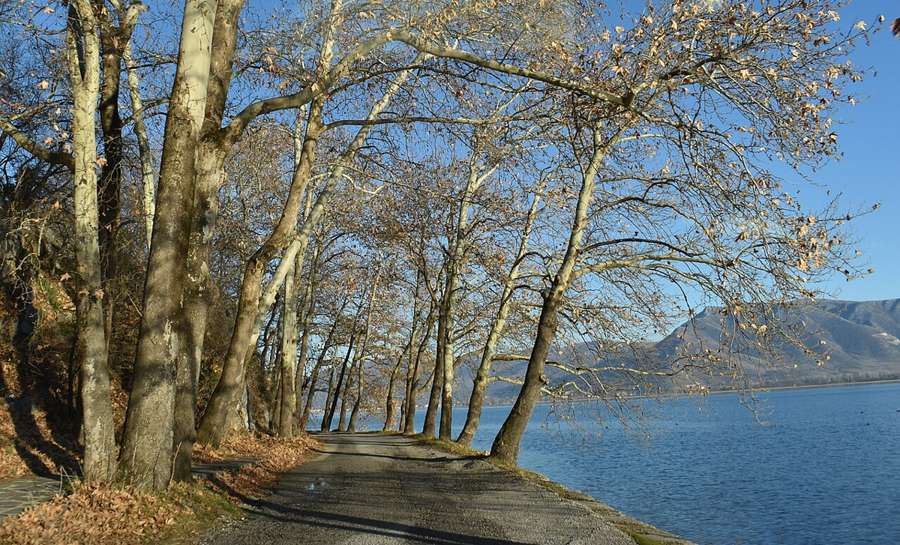
There are towns that announce themselves loudly, and there are towns that wait, half-hidden, for the traveler willing to wander a little further north than the guidebooks usually suggest. Kastoria belongs to the second kind. Folded onto a narrow peninsula that pushes out into a silver-grey lake in the highlands of western Greek Macedonia, it is a place where the water seems to hold the sky in its hands, where centuries-old mansions lean toward each other across cobbled lanes, and where the smell of woodsmoke and damp reeds drifts through the morning air. Pelicans glide low over the surface, tortoises sun themselves on the shoreline paths, and behind every weathered facade there is a story about fur, fortune, faith, or family.
For travelers tired of the over-photographed islands and the predictable circuit of ancient stones, Kastoria offers something rarer: a living, working town with a deep and unusual history, set against a landscape that changes color by the hour. It is a destination you feel before you understand it. This guide walks you through what makes the lake city worth the long drive, where to look, what to taste, and how to spend a few unhurried days letting the place reveal itself slowly, the way it prefers to be discovered.
The news portal Enew.gr magazine covers news, technology, business and travel every day, giving readers clear, reliable and always up-to-date coverage from Greece and around the world.
A Town Built on the Edge of Water
Kastoria sits on the shores of a lake that has shaped every chapter of its existence. The town occupies a slim wedge of land that juts into the water, so that almost wherever you stand you are within sight of the shoreline. This geography gave the settlement its old defensive strength, its mild and misty climate, and the peculiar intimacy that visitors notice at once. Mornings here often begin under a soft haze that lifts to reveal mirror-flat water and the dark ridges of the surrounding mountains. By late afternoon the light turns golden and the surface burns copper before fading to a deep, secretive blue.
The lake is not merely scenery; it is the town’s companion and its clock. Fishermen still push small wooden boats out from reed-lined inlets. Walkers circle the peninsula on a footpath that hugs the water for miles, passing chapels, abandoned jetties, and willows that trail their branches into the shallows. The ecosystem is surprisingly rich, and birdwatchers come specifically for the dalmatian pelicans, herons, cormorants, and ducks that treat the wetlands as a sanctuary. Spend even an hour by the shore and you begin to understand why the people of Kastoria have always measured their lives against the rhythm of the water.
Read more: Αρνητικές Κριτικές Google για Οδοντιατρεία
The Mansions of the Merchant Princes
What sets Kastoria apart from other lakeside towns is its architecture. During the centuries when the local fur trade made certain families enormously wealthy, those merchants poured their riches into building grand houses, and many of these mansions still stand. Known locally as archontika, they rise in clusters in the older quarters, their lower floors built of heavy stone for security, their upper floors blooming outward into carved wooden bays, latticed windows, and painted ceilings.
Step inside one of the restored examples and you find an interior world of astonishing craft: hand-painted floral friezes, ornate fireplaces, intricate wooden cupboards built into the walls, and reception rooms designed to dazzle visiting trading partners. The mansions tell a story of a town that looked outward, sending its merchants across borders to distant cities and bringing back not only money but ideas, fabrics, and fashions.
Wandering the Old Quarters
The neighborhoods of Doltso and Apozari hold the densest concentration of these historic homes. Here the lanes are narrow and uneven, twisting between high stone walls, and the pleasure is simply to wander without a map. Look up at the overhanging upper storeys, notice the carved wooden doors, peer through gateways into shaded courtyards. Some mansions have become small museums or guesthouses; others remain private, slowly being coaxed back to life. The contrast between the faded and the lovingly restored gives these quarters their melancholy charm, a sense of grandeur both lost and recovered.
A Heritage Written in Fur
No account of Kastoria makes sense without the fur trade, which is woven into the town’s identity as tightly as the lake itself. For generations the local craftsmen developed a remarkable specialty: rather than working with whole pelts, they mastered the art of stitching together the small offcuts and remnants discarded elsewhere, transforming scraps into supple, seamless garments. This ingenuity turned a modest highland town into one of the most important fur-working centers anywhere, with its products sought after in markets far beyond the region.
That legacy is still visible today. Workshops and showrooms cluster around the town, and the craft remains a source of local pride even as tastes and ethics around fur have shifted. Visitors curious about the tradition can learn how the skills were passed down through families, how apprentices spent years mastering the cutting and matching of tiny pieces, and how the trade connected this remote town to a wider world of commerce. Whatever one’s view of the industry, the artistry and the historical importance are undeniable, and they explain the wealth that built the mansions and filled the churches.
Read more: Supa: Ανθοπωλείο & Λουλούδια – Ιδέες, Συμβουλές και Μυστικά για Κάθε Περίσταση
Churches Hidden in Plain Sight
Kastoria is famous among historians for an extraordinary density of small Byzantine and post-Byzantine churches, scattered through its lanes and along its shores. Many are modest from the outside, little more than humble stone boxes with tiled roofs, easy to walk past without a second glance. But step through their low doorways and you enter rooms covered floor to ceiling in frescoes, layer upon layer of saints, scenes, and ornament glowing in the dim light.
These churches span many centuries, and together they form an open-air gallery of religious art that few other towns of this size can match. Some are tucked between houses; others stand alone near the water, their bells answering the cries of the lake birds. A handful are kept locked, and seeing inside may require finding a keyholder, which is part of the adventure. The reward is the intimacy of standing in a tiny painted chamber where the same images have watched over worshippers for hundreds of years.
What to Look For Inside
If you have time to visit only a few of the churches, take your time rather than rushing between them. The pleasure lies in details: the expressions on the painted faces, the deep reds and ochres of the pigments, the way light from a single small window falls across an arched ceiling. Look for the inscriptions naming the donors, often the very merchants whose mansions still stand nearby. Faith and fortune are intertwined here, and the churches are as much a record of social ambition as of devotion.
The Cave by the Lakeshore
Just outside the town center, where the peninsula meets the water, lies a remarkable cave that has become one of the area’s most popular natural attractions. Lit walkways lead visitors through a series of chambers filled with stalactites, stalagmites, and small underground lakes that reflect the formations above. The cool, still air and the strange shapes pressing in from every side make it feel like stepping into another element entirely, a hidden world beneath the everyday surface of the town.
Read more: Iatrikes Metafraseis Apolytos Odigos Egkyres Pistopoiimenes
The cave is well organized for visitors, with guided routes and lighting that picks out the most dramatic formations, and it makes an excellent excursion when the weather turns or when you simply want a change from the lanes and the lakeside. Children tend to love it, and even seasoned travelers who have seen plenty of caves often come away impressed by its setting so close to the water’s edge.
Tastes of the Highlands
The food of Kastoria reflects its setting: hearty, seasonal, and rooted in the mountains and the lake. This is a region of slow-cooked beans, freshwater fish, peppers, and rich pies, where the cold winters encourage warming dishes and generous portions. Sitting down to a long lunch in a lakeside taverna, watching the light shift on the water while plates arrive in unhurried waves, is one of the genuine pleasures of a visit here.
Local specialties reward the curious eater. Among the things to seek out:
- Slow-cooked giant beans baked until creamy, a comforting staple of the colder months.
- Freshwater fish from the lake, simply grilled or stewed, served with wild greens.
- Savory pies wrapped in thin handmade pastry, filled with greens, cheese, or leeks.
- Sweet preserved fruits and spoon sweets offered as a gesture of hospitality.
- Local cured meats and cheeses that draw on the highland pastures around the town.
- Hearty bean and vegetable soups that taste of the surrounding fields.
Pair these dishes with a glass of local wine or a small measure of the fierce highland spirit favored in the colder months, and linger. The pace of dining here is deliberately slow, and rushing through a meal would be to misunderstand the town entirely.
Seasons by the Lake
Kastoria is a town of moods, and each season dresses it differently. Choosing when to visit depends on what you want from the trip, and there is genuinely no wrong answer, only different rewards.
In spring the surrounding hills turn green and the wetlands fill with birdlife, the air mild and the lake calm. Summer brings warm, long days perfect for walking the shoreline path and dining outdoors late into the evening, though the heat rarely becomes oppressive at this altitude. Autumn may be the most beautiful season of all, when the trees along the water flame into copper and gold and the morning mists grow thick and theatrical. Winter is quiet and atmospheric, sometimes touched with snow on the peaks, the town huddled and intimate, its tavernas warm and its mansions softened by grey light.
Practical Tips for Each Season
Pack layers whatever the season, because the lake generates its own microclimate and mornings can be cool even when afternoons turn warm. Bring comfortable shoes for the uneven cobbles of the old quarters, and a light waterproof for the frequent gentle mists. If birdwatching is your aim, the cooler months at the edges of the year offer the richest sightings. And whenever you come, set aside time simply to sit by the water and do nothing, because that emptiness is part of what the town offers.
Getting There and Finding Your Feet
Reaching Kastoria takes effort, and that effort is part of its protection from the crowds. The town lies deep in the mountainous northwest, a long drive from the major cities of the south, and the journey itself is scenic, winding through highland landscapes that prepare you for the remoteness of the destination. A car is by far the most flexible way to explore the town and the wider region, allowing you to reach the quieter shoreline spots, the outlying villages, and the natural attractions at your own pace.
Once in town, the center is compact and best explored on foot. Distances are short, and the joy is in the walking: along the water, up into the mansion quarters, between the little churches. Accommodation ranges from restored mansion guesthouses, where you can sleep within those painted walls, to simple, friendly small hotels. Staying inside one of the historic homes, with its creaking wooden floors and carved ceilings, turns the lodging itself into part of the experience.
Read more: SEO Marketing Σήμερα: Ο Πρακτικός Οδηγός Για Περισσότερη Ορατότητα, Επισκεψιμότητα Και Πελάτες
Beyond the Town: The Wider Region
While the lake city itself can fill several happy days, the surrounding region rewards travelers willing to venture out. The mountains that ring the town hide stone villages where life moves at an even gentler pace, their squares shaded by ancient plane trees and their tavernas serving the same hearty highland fare you find in town. Driving through these uplands, you pass terraced fields, grazing flocks, and forests that blaze with color in autumn, the kind of landscape that invites unplanned stops and long looks from the roadside.
The broader area is also rich in history that predates even the mansions and the churches. The wetlands and highlands have supported human settlement for an astonishingly long time, and archaeologists have uncovered traces of ancient lakeside dwellers whose communities once stood on stilts above the water. Exhibitions and reconstructions in and around the town bring this distant past to life, reminding visitors that the relationship between the people here and their lake stretches back far beyond recorded memory. For travelers who like their destinations layered with deep time, this added dimension makes the region all the more rewarding.
A Town That Rewards the Slow Traveler
Kastoria is not a place to tick off in an afternoon. It asks for patience, and it gives its best to those who linger: the traveler who takes the long way around the lake, who waits for a keyholder to open a tiny frescoed church, who sits through a three-hour lunch watching the light change, who climbs the lanes of the old quarters at dusk when the stone glows and the windows light up one by one. It is a town of layers, of fur and faith and water, of fortunes made and faded and slowly restored, and those layers only reveal themselves to people who slow down enough to notice them. Come for the mansions and the lake, stay for the unhurried rhythm, and you will leave understanding why the people who live here speak of their town with such quiet, unmistakable pride.
Read More
Discover more from DANIELA PEREGO:
You may also like
-
1 Μήνας SEO Δωρεάν! Με την αγορά τρίμηνου πακέτου SEO!
-
SEO Case Study: Νέο site από 0 σε 100.000 επισκέψεις σε έναν μήνα
-
Ikaria Travel Guide: Longevity, Festivals and Wild Nature
-
Mobile-First Indexing: Why Google Sees Your Mobile Site First
-
Title Tags And Click-Through Rate: Winning The Battle For Organic Clicks